






















By Fr Theo Ekwem
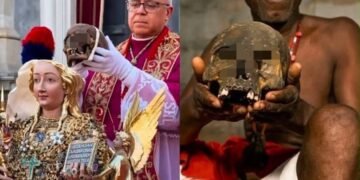
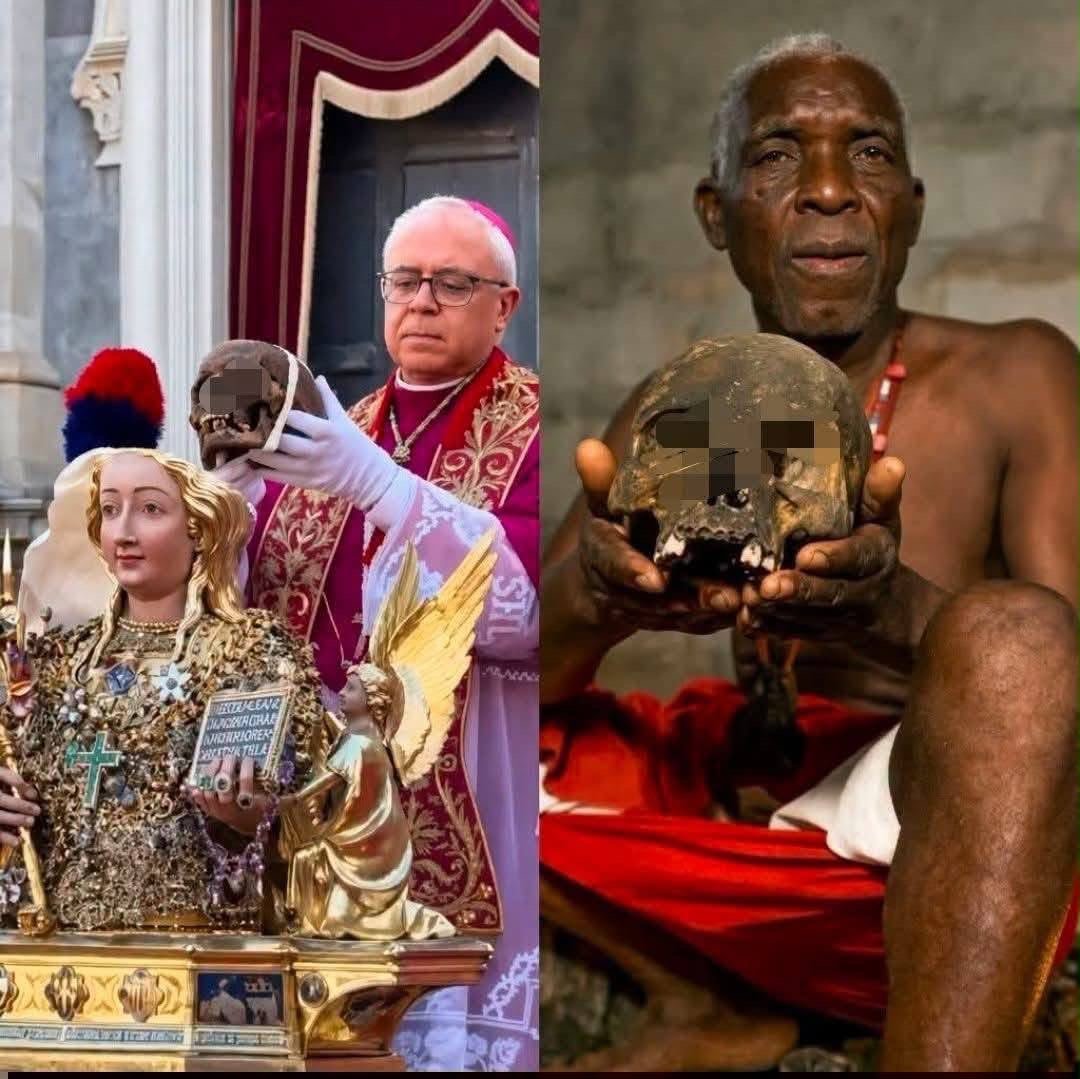
With a few private/public tags and having observed today the trending news and debate sorrounding the recent veneration of the relic of St Agatha to mark the 900th Anniversary of her relic return to Catania, Sicily, her birth place, I now make my apologetic public.
- Catholic Altars and “Human heads”: A student once walked up to a priest who also doubled as the school principal and asked: Fr, is it true that there is a human head buried under the ground where the altar is elected in every Catholic Church? The priest was rattled by the question and sought to know the background that led to the thought and the question. Further dialogue with the student revealed that another student ( non Catholic) in a higher class has “sold the opinion” to a group of junior students, suggesting the Church complicity or direct involvement in ritual killing/sacrifice. The Priest- Prinicpal would later respond to the original question dramatically before all the students. He came to Mass the next time, and moved the altar (luckily it was a movable one) to a different location, and during the homily requested the students to come and dig out the human head buried under the ground where the altar was originally placed. That was the “entry behaviour” before the proper catechesis that addressed the non Catholics allegations and misunderstanding about church teaching on Relics.
- Relics in the Sacred Scriptures:
The word “relic” has a Latin root “reliquiae” which means “remains” or the verb “relinquere” implying “to leave behind”. Does it make you think about the English word “relinquish”? Relics in the Church therefore referes to objects associated with Christ and the Saints that are left behind. They are categorized into three: First Class Relics (bodily remains), Second Class Relics (items used by the Saints) and Third Class Relics (Objects touched by the first class relics). In 2kings 13: 20-21 the bone of Elisha (first class relic) was a source of God’s miracle in bringing a dead man back to life. Again, 2kings 2:14, the cloak of Elijah (2nd class relic) was used by Elisha to divide the sea. In Acts 19:12, the handkerchief and apron of St Paul (3rd class relic) was taken to the sick for healing and expulsion of evil spirits. Dont forget that the hearmoghage woman touched the cloak of Jesus (first class relic) and was well (Matt.9:20), and even Peter’s shadow on the street is believed to bring healing to the sick(Acts 5:15).
The thesis of the above biblical citations is that Relics as source of God’s miracle, (not in themselves but, a channel) is scriptural and not a “Catholic- human” invention.
- Relics vs First Commandment
In Exodus 20:4, God said: “You shall not make for yourself an image in the form of anything in heaven above or on the earth beneath or in the waters below”. This is a further instruction on first commandment which says: “thou shall not have anyother god beside me”. It is pertinent to note that these verses forbade us not to worship any other god. It did not forbade us against veneration and use of Sacred images. Thus, Relics in the Church are not worshipped but VENERATED. Veneration is honour, and does not constitute to Idol worship (idolatry). Rightly understood, remember, same God ordered that a bronze serpent be hung, and anyone who looked at it will recieve healing (Numbers 21: 8-9). Do you consider that as Idolatery? Was the healing from the bronz serpent or from God? God also instructed Solomon to make images of Cherubim (Angels) in the temple – 1kings 6:23-28). Recently (May, 2026), I made a trip with school children to Washington DC/Virginia. If you want to witness a sociological praxis of veneration, visit the “tomb of the Unknown Soldier” in Arlington National Cemetry in the United States At this tomb, for 24/7 all year since 1937, there is a 21 steps veneration by the military guard. That is not “Worship of the dead”. It is rather, a veneration, akin to what we Africans call “Ancestral veneration” when we pour the libations and throw the piece of the kola nut to the ground while calling on the ancestors.
Is our Ancestral veneration, idolatry or idol worship? St. Pope John Paul II in his 1995 Post Synodal Exhortation, “Ecclesia in Africa” urged us to build on this practice as an openess to fully realize the theology of Communion of the Saints. (Nos 42-43).
Again when governor Ademola Adeleke in a typical Yoruba ethics prostrated fully on the ground before his billionaire elder brother Adedeji Adeleke (Davido’s father) in appreciation for his contribution to his electoral success, was that worship or honour?
- The Big Question: Whose Skull, Whose bones?
Truly, the pictures were not only sensitive but ‘scary’. Yes, for someone whose background deals with the reality of human ritual killings, and the ugly sites of bursted kidnappers den and the exhumation of human skulls and other parts of skeletons, the “St Agatha picture and video” in the context can really trouble the mind and the soul. But a question beckons: Whose skull? Whose bones? Whose handkerchiefs? Whose aprons? Whose shadows? At Catania, it was the veneration of the skull of St Agatha, a 3rd Century Martyr of the Church, whose life and history is known. The Church insists that a relic must have a carefully documented origin. Their authenticity must be certain or probably certain to a reasonable extent.
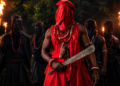
Whose skull is your chief priest having in his hands, and to what end? This question also entails a detailed account of the origin of the skull in his hands, the persons life and history and the circumstances sorrounding his or her death. Again. I ask, whose skull is that, and to what end?
- Like St Agatha, like Blessed Iwene Tansi
The first class relic of St Agatha generated this discussions about the veneration of relics in the Catholic Church which is an ancient tradition of the Church. The early Church prefers to have Masses celebrated over the tomb of the Martyrs, believing that like the bones of Elisha, God would use them for miracles. It is on this basis too, that most Churches have relics of the Saints placed or fixed on the altar; or a side altar.
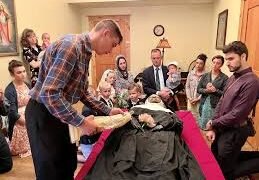
At the Basilica of Holy Trinity we have a first class relic of our brother Blessed Micheal Iwene Tansi at the side altar. Fr Tansi died on 20th January, 1964 at Mount Bernard Monastery England, and was buried there. However, in response to popular demand for his beautification process, the then Archbishop of Onitsha +Stephen Ezeanya, in 1984 requested for the remains of Fr Tansi to be brought home. The request was granted and his remains was exhumed in England and returned to Nigeria and reinterred at the priests cemetery at Holy Trinity Basilica Onitsha on 17th October, 1984. On that same day, the first miracle of healing of a young teenage girl, Philomena Emeka of malignant cancer when she touched the Tansi remains was recorded. There was a second reinterrment on October 17th , 1986. He was beatified by St Pope John Paul II on March 22, 1998, and he became the first West African in recent history to be so hooured. The relic of Bl. TANSI at the Basilica has been a pilgrimage center for many. There also Tansi Pilgrimage center at Aguleri, his hometown. Interestingly, in July 2023, Fr Emmanuel Obimma (Ebube muo nso) of Holy Ghost Adoration Ministry Uke traveled round United States with the relic of Tansi, promoting the veneration and seeking God’s miracles. The veneration St Agatha gets from the Catania, Blessed Tansi gets too, from Catholics in Nigeria. Have you venerated the relic of Blessed Micheal Iwene Tansi?
- Reliquary is always better.
Yes, the picture of St Agatha skull was sensitive, and more sensitive depending on your socio-cultural experiences. May be, if it was carried on a reliquary or box, it may not have generated such worries. However, it is a veneration, and not worship. That is the way of many saints, in hope that God would by their relics work further miracles as in Elisha’s bone, Elijah’s cloak, Peter’s shadow, St Paul’s apron and so on. Such is the tradition of the Church founded on Sacred Scriptures.
- Fath, not Mathematics
At the end, Faith experience is not “Mathematics”. The Theology of Incarnation as foundational to “Divine- Human” Exchange which relics also points to is not scientifically certain to the mind. It is about “fides quaerens intellectum” (Faith seeking understanding). Every Christians should with humility and faith, cry out at all times like the man in the crowd saying “Lord, I believe; help my unbelief”
If the above makes no sense to you either as a Christian or non Christian, St Thomas Aquinas have a final word for you: “To one who has faith, no explanation is necessary. To one without faith, no explanation is possible”.
Thank you.