

























There are moments in the life of a people when culture stops feeling like something inherited by default and begins to feel like something that must be consciously chosen. That subtle but profound shift in ideology marks the difference between a heritage that survives and one that disappears quietly through neglect. The growing cultural awakening across Igbo land belongs to that category of moments: a slow but visible return of identity, language, and pride that had, for a long time, been strained by modernisation, aspiration, and the pressure of external validation. For years, Igbo language carried an unspoken burden in many spaces. It was often treated as secondary in homes where English was seen as the passport to success, mobility, and social acceptance. In some cases, children grew up understanding Igbo but hesitating to speak it fluently. In others, they understood fragments but lacked confidence in expression. Over time, what should have been a natural cultural rhythm suffered a displacement in the pursuit of what was perceived as advancement.
Yet cultures do not vanish suddenly. They recede through repetition: what is spoken at home, what is rewarded in schools, what is affirmed in public, and what is allowed to fade without resistance. The consequence of those accumulated choices is what many communities are now beginning to confront with a renewed sense of responsibility. In that context, the renewed visibility of Igbo language and culture within academic spaces is not a minor development. It is a symbolic correction. When institutions of learning begin to consciously integrate identity into their formation of young people, they are restoring balance between intellect and heritage. It signals that education is not complete if it produces graduates who are globally competent but locally disconnected.
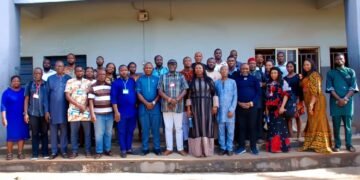
Within this broader cultural reawakening, Shanahan University, Onitsha stands out in a particularly instructive way. What makes its approach notable is not simply that it hosted a cultural celebration, but that it did so as part of a wider educational philosophy that refuses to treat human development as fragmented. There is a growing tendency in many academic environments to compartmentalise development; intellectual training in one corner, moral formation in another, and cultural identity somewhere on the margins, often reduced to occasional performances. Shanahan University’s stance appears to challenge that fragmentation.
By placing Igbo language and culture within its institutional culture, the university signals a more integrated understanding of what it means to educate a person. A university, after all, is not only a space for knowledge acquisition but for identity formation. It is where young minds are shaped not just to think critically, but to understand who they are within the continuum of history, language, and community. In that sense, a celebration of culture within such a space is formative. What makes Shanahan University particularly distinctive is this refusal to overlook any dimension of human development. Intellectual growth is pursued alongside moral grounding, social awareness, and cultural continuity. In many institutions, cultural identity is treated as an optional layer; something added when convenient. Here, it is being positioned as part of the structure itself.
This is why the emphasis on Igbo language within such a setting carries deeper meaning. When students are exposed to their language and culture not as relics of the past but as living systems of meaning, they are more likely to carry that consciousness into broader society. The classroom, in that sense, becomes a site of cultural preservation as much as intellectual development.
The phrase “Igbo ga-adi” therefore finds renewed resonance in such spaces. It is not merely a declaration of survival but a statement of intentional continuity. Languages do not endure by sentiment; they endure by systems—systems of use, teaching, pride, and reinforcement. When those systems are consciously embedded in institutions that transform young minds, culture gains structural support rather than emotional appeal alone.
What is unfolding across Igbo cultural spaces today, therefore, is a recalibration. A reassessment of what has been undervalued, and a quiet insistence that identity is not separate from development. Shanahan University’s example fits within that recalibration. Theirs is a reflection of what becomes possible when an institution chooses to see education in full human terms.