
























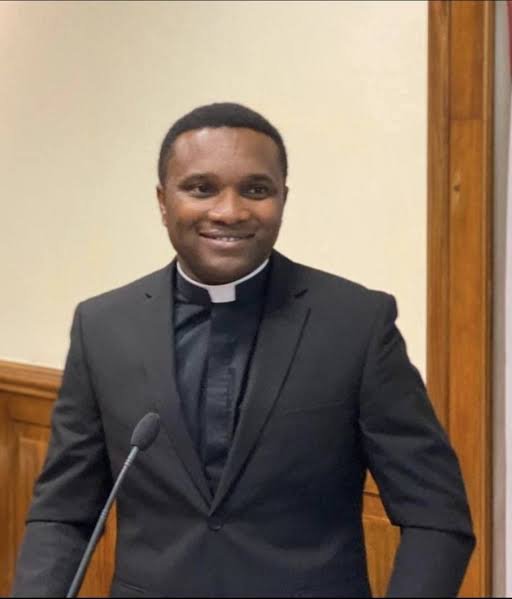
Fr George AdimikeThe priesthood is one of God’s most enduring affirmations of humanity. In every generation, it remains an unmistakable response of God to a world longing for hope. Through and in the person of the priest, Christ continues his salvific work,, transforming ordinary moments into encounters with grace. In his ministry, the rendezvous of the ordinary and the supernatural is consummated. Indeed, the altar becomes the meeting point of heaven and earth, and from it flows a ministry whose true measure is found in lives renewed, communities transformed and institutions. While priests generally leave behind good memories, some leave behind movements of grace that reshape the destiny of a people. As Most Rev. Valerian Maduka Okeke marks forty-five years of his ordination to the Catholic priesthood―11 July 1981to 11 July 2026―at the hands of Francis Cardinal Arinze, one beholds in him a radiance of God’s graciousness.
It has been forty-five years of an enduring participation in Christ’s own mission of giving life in abundance. That conviction has remained the golden thread running through every chapter of his ministry. It is therefore fitting that this Sapphire jubilee coincides with his recognition as the inaugural Anambra Person of the Decade. Indeed, the Archbishop is the first and only individual so far to be conferred such a prestigious award. The honour does not merely celebrate an eminent shepherd of souls; it acknowledges a priest whose vocation has become one of the defining forces in the spiritual, educational and social transformation of Anambra and beyond.
From his early years in parish pastoral work to his service as Rector of Bigard Memorial Seminary, where he contributed to the formation of a new generation of priests, and from his appointment as Coadjutor Archbishop to his succession as Archbishop of Onitsha in 2003, following the retirement of Archbishop Albert Obiefuna, Archbishop Okeke has approached leadership with a remarkably coherent theological vision, the human person in Christ is preeminent (Maduka). His episcopal motto, Ut Vitam Habeant—“That they may have life” (John 10:10)—is neither decorative nor symbolic. It is the hermeneutical key through which his entire episcopacy is best understood. Every initiative he has championed, every institution he has nurtured and every pastoral decision he has taken bears witness to a shepherd convinced that the Gospel must never remain confined to liturgical celebration alone; it must generate life intellectually, spiritually, socially and economically.
Few aspects of that vision have been as transformative as his commitment to education. The return of mission schools to the Church in Anambra State presented not merely an administrative opportunity but a profound evangelical responsibility. Archbishop Okeke understood that reclaiming school buildings without reclaiming their soul would amount to little more than recovering bricks and mortar. Education, for him, has always been a continuation of evangelisation, forming minds capable of critical thought while nurturing hearts rooted in faith, integrity and service, equipped with relevant skills. Under his leadership, the Archdiocese embarked upon an ambitious programme of renewal that combined infrastructural rehabilitation with a deliberate restoration of Christian identity. Priests trained as school managers, ensuring that the spiritual ethos of Catholic education was once again woven into the daily life of the schools. Teachers underwent continuous professional formation, while academic excellence was pursued alongside moral discipline and character formation, creating educational communities where intellectual achievement and Christian virtue reinforce rather than compete with each other.
The fruits of that vision have become visible far beyond the boundaries of Anambra State. Schools under the Archdiocese have repeatedly distinguished themselves in national and international competitions, demonstrating that faith-inspired education can also produce global excellence. Regina Pacis Secondary School, Onitsha, has become an internationally recognised symbol of academic innovation, gaining worldwide attention through its remarkable performances in science, technology and robotics competitions, including success at the Technovation World Challenge, where its students demonstrated that Nigerian girls, when properly formed and equipped, could compete confidently on the global stage. Christ the King College, Onitsha, one of Nigeria’s oldest and most prestigious Catholic institutions, has continued to sustain its reputation for excellence, with students achieving international recognition in competitions such as the World Affairs Challenge while maintaining a tradition of producing leaders in diverse professions. Queen of the Rosary College, Onitsha, similarly brought honour to both Church and nation through its impressive performance at the prestigious Diamond Challenge, illustrating once again that Archbishop Okeke’s educational philosophy extends beyond examination success to the cultivation of creativity, innovation and entrepreneurial thinking among young people. Yet Mater Amabilis Secondary School Umuoji has distinguished itself as the best secondary school in Nigeria for the education of the girl-child. The litany of its victories and award is endless.
These achievements are not isolated triumphs to be celebrated merely for the trophies they produced. They are not “one off” but “one of the many”; they are the pattern of all other Catholic Schools in the Archdiocese. They reveal something deeper about the Archbishop’s understanding of education itself. Long before conversations about STEM education became fashionable, schools under his pastoral care were already investing deliberately in science, technology, engineering and mathematics, encouraging participation in robotics, coding, innovation fairs and international scientific exchanges. The remarkable accomplishments of these students have demonstrated that Catholic education need not choose between faith and scientific advancement. Rather, Archbishop Okeke has consistently advanced the conviction that faith illumines reason and that the pursuit of scientific knowledge becomes noblest when guided by moral wisdom. In an age increasingly tempted to separate technological progress from ethical responsibility, his schools have quietly offered an alternative vision in which academic brilliance is inseparable from integrity, compassion and service to humanity.
Yet perhaps the crowning expression of this educational renaissance is the establishment of Shanahan University, the first university in Onitsha. Named after Bishop Ignatius Joseph Shanahan, whose missionary zeal laid the foundations of Catholicism in Eastern Nigeria and beyond, the university represents far more than another addition to Nigeria’s expanding landscape of tertiary institutions. It embodies the culmination of decades of patient investment in human capital and intellectual formation. Archbishop Okeke did not establish Shanahan University merely to confer degrees; he envisioned a community of scholarship where knowledge would remain inseparably united with virtue, where research would serve humanity, and where graduates would emerge not only professionally competent but morally grounded. In many respects, Shanahan University is the flowering of seeds planted long before its official establishment—the natural progression of an educational philosophy that has consistently sought to accompany learners from the earliest years of formation through the highest levels of academic inquiry.
What distinguishes Archbishop Okeke from many institutional builders, however, is that his works have always been sustained by thoughtful theological reflection. Throughout his episcopacy, his annual pastoral letters have provided the intellectual and spiritual rhythm of the Archdiocese, inviting priests, religious and laity alike to reflect deeply on the pressing questions confronting both the Church and society. These letters are catechetical, pastoral and theological texts that reveal a bishop committed to forming minds as carefully as he forms institutions. In Catholic Education and National Development (2014), he articulated education as an indispensable instrument for rebuilding society, insisting that schools exist not merely to produce skilled professionals but responsible citizens whose values contribute to the common good. In The Holy Eucharist: Our Strength (2019), he returned to the sacrament that has always occupied the centre of his spirituality, presenting the Eucharist as the inexhaustible source from which Christian life, family life and missionary discipleship continually draw strength. His 2021 pastoral letter, The Priesthood: Gift and Sacrifice, reflected with profound gratitude on the beauty and demands of priestly vocation, reminding both priests and faithful that authentic ministry is sustained not by privilege but by joyful self-offering after the pattern of Christ. Most recently, On Virtues and Capital Sins (2026) challenged the faithful to recover the moral foundations necessary for personal holiness and social renewal, demonstrating once again that the Archbishop continues to engage contemporary realities not merely through institutional leadership but through sustained theological teaching.
The wider pastoral overview of the Archdiocese reveals an equally compelling testimony to a shepherd who has consistently understood that the Gospel must be encountered where people live, work, suffer and hope. When he assumed the pastoral governance of the Archdiocese of Onitsha in 2003, he inherited a flourishing local Church built upon the sacrifices of his predecessors. Yet, rather than merely preserving that inheritance, he embraced the responsibility of deepening and expanding it, laying the foundation for a great Church for the next century. Over the course of his episcopacy, the number of parishes has grown from about seventy to about one hundred and eighty, bringing the Eucharist, the sacraments and pastoral care within closer reach of countless communities. Every new parish has represented far more than an administrative division; it has become another hearth around which Christian families gather, another sanctuary where children encounter Christ for the first time, another centre from which faith, charity and community development radiate into society. In many rural and emerging urban communities, the establishment of a parish has often been accompanied by the construction of schools, health facilities, parish halls and other social infrastructure, demonstrating once again that authentic evangelisation does not merely proclaim the Gospel but also creates the conditions in which human dignity may flourish.
This vision found one of its most enduring symbols in the Basilica of the Most Holy Trinity, Onitsha. Already the spiritual heart of the Archdiocese, the cathedral assumed even greater significance when it was elevated to the dignity of a Minor Basilica, becoming the first and only basilica in Nigeria. While such recognition reflects the Church’s esteem for the historical and liturgical importance of the cathedral, Archbishop Okeke understood that a basilica should never become a monument to ecclesiastical prestige. Instead, it should stand as a visible proclamation of the beauty of God and the unity of His people. It is therefore unsurprising that he convoked the first Archdiocesan Synod, inviting clergy, religious and lay faithful into a shared discernment about the future of the local Church. The Synod was an expression of his conviction that the Church journeys most fruitfully when it listens together, prays together and plans together under the guidance of the Holy Spirit. In doing so, he consolidated structures of communion while preparing the Archdiocese to meet the pastoral challenges of a rapidly changing society with renewed confidence and missionary purpose.
Yet Archbishop Okeke’s understanding of abundant life has never been confined to the sanctuary or the classroom. The healing ministry of Christ has found tangible expression through the remarkable development of Catholic healthcare institutions across the Archdiocese. Hospitals such as Charles Borromeo Specialist Hospital, Onitsha, Holy Rosary Specialist Hospital and Maternity, Waterside, Immaculate Heart Hospital, Nkpor, St. Martin’s Hospital, Ugwuoba-Obosi and Our Lady of Fatima Hospital and Maternity, Awka-Etiti, among so many others, have continued to expand in infrastructure, personnel and quality of service under his pastoral leadership, providing compassionate healthcare to thousands of families irrespective of religious or social background. These institutions embody the ancient Christian conviction that the care of the sick is itself a proclamation of the Gospel. For Archbishop Okeke, every hospital ward is an extension of Christ’s healing touch, where professional excellence and compassionate service converge in defence of the sanctity of human life.
Remarkably, his vision has also embraced the economic foundations necessary to sustain the Church’s mission. Long before conversations about institutional sustainability became commonplace within ecclesiastical circles, he recognised that prudent stewardship demanded innovative structures capable of supporting evangelisation, education and social outreach. The growth of Oluchukwu Microfinance Bank into one of Nigeria’s leading micro-finance institutions reflects this farsighted and great managerial approach. Beyond providing financial services, the bank has empowered countless small-scale entrepreneurs, traders, farmers and families, helping them transform modest opportunities into sustainable livelihoods. In the same spirit, the establishment of Oluchukwu Oil and Gas demonstrates a willingness to engage the realities of modern enterprise without compromising the moral principles of the Church. These initiatives reveal a bishop who understands that economic responsibility is not opposed to spirituality; rather, when guided by integrity and accountability, it becomes another instrument through which the Church safeguards her mission and extends her charitable outreach.
The same missionary imagination gave birth to Radio Sapientia, a medium through which the Gospel continues to transcend geographical boundaries and enter homes, marketplaces and workplaces across the region. Through its programmes of evangelisation, catechesis, education and civic engagement, the station has become far more than a broadcaster; it has become a digital pulpit carrying the Church’s voice into everyday life. In an age increasingly shaped by media, Archbishop Okeke recognised that the Church must not merely respond to culture but actively participate in defining it with truth, hope and wisdom.
His concern for the future of both Church and society is perhaps nowhere more evident than in his unwavering commitment to young people. The Holy Family Youth Village stands as a powerful testimony to his conviction that the greatest investment any society can make is in the integral formation of its youth. Designed as a centre for spiritual renewal, leadership formation, vocational discernment and human development, it reflects a pastoral philosophy that sees young people not as passive recipients of ministry but as protagonists in the Church’s mission. This same commitment is evident in his encouragement of advanced academic formation for priests, many of whom have pursued specialised studies in theology, philosophy, medicine, law, engineering, pharmacy and the social sciences, producing the highest number of priests with PhD in Nigeria. Consequently, the Archdiocese has continued to produce priests capable of engaging contemporary society with intellectual depth, pastoral sensitivity and professional competence.
Among the most moving chapters of Archbishop Okeke’s priesthood, however, are those written behind the walls of the Onitsha Correctional Centre. For well over two decades, he has made it a personal tradition to celebrate Christmas, Easter and even his birthdays with inmates, refusing to allow incarceration to become exclusion from the embrace of the Church. His ministry there has consistently gone beyond sacramental celebrations. Through the provision of food, clothing, boreholes, educational materials, vocational training facilities and sustained pastoral accompaniment, he has helped transform the correctional centre into a place where rehabilitation is pursued with genuine hope. It was in recognition of this extraordinary commitment that the Nigerian Correctional Service honoured him as its distinguished patron―Grand Patron, the first and the only so far. Few images capture the essence of his priesthood more eloquently than that of a bishop breaking bread with those whom society has often forgotten, quietly affirming that no human life lies beyond the reach of divine mercy.
The missionary horizon of his episcopacy extends even beyond the boundaries of Nigeria. Under his leadership, priests of the Archdiocese now serve in numerous countries across Africa, Australia, Asia, Europe and North America, carrying with them the rich spiritual heritage of the Church of Onitsha. Their presence across continents bears witness to a local Church that has matured from receiving missionaries to becoming a missionary Church in its own right. It is a remarkable reversal of history and a fitting tribute to the missionary legacy of Bishop Ignatius Joseph Shanahan and the early missionaries whose labours first planted the seeds of faith in Igboland.
When viewed together, these accomplishments reveal an extraordinary consistency of vision. Archbishop Okeke has remained faithful to a single evangelical conviction: that the Church exists so that all may have life, and have it abundantly. His ministry has never been driven by the desire to accumulate projects but by the deeper desire to incarnate the Gospel in every sphere of human existence. The institutions he has established are therefore not monuments to personal ambition but enduring channels of grace through which countless lives continue to encounter Christ.
It is against this background that his recognition as the inaugural Anambra Person of the Decade acquires its fullest meaning. The honour is not simply a celebration of longevity, prominence or ecclesiastical office. It is the gratitude of a society that has witnessed the transformative power of faithful priesthood expressed through visionary leadership.
Long after anniversaries have passed and accolades have faded, the schools that continue to produce global champions, the university transforming future generations, the hospitals restoring health, the parishes nurturing faith, the correctional centre where hope has been rekindled, the businesses sustaining the Church’s mission and the missionary priests serving across continents will continue to speak. They are the living chapters of a priesthood that has refused to separate worship from service, contemplation from action, or faith from the concrete realities of human development. In celebrating Archbishop Valerian Maduka Okeke at forty-five years of priestly ministry, the Church celebrates a shepherd whose life has quietly transformed the spiritual and social architecture of a people. The fragrance of that priesthood lingers because it has become inseparable from the life it has given to countless others. Indeed, his is a fragrance born of sacrifice, sustained by grace and destined, by God’s providence, to endure for generations yet unborn. In a word, Archbishop Valerian Maduka Okeke radiates God’s graciousness. Congratulations, Anambra Person of the Decade. Felicitations, Father Val. To God be the glory, Archbishop Valerian M. Okeke.
Fr George Adimike
findfadachigozie@gmail.com